I had a free morning in Los Angeles and no particular plan. Someone mentioned the Getty Center was nearby. I'd seen photographs of it (everyone has) but I had no real sense of the place beyond the standard images that circulate online. I took the tram up the hill with the X2D and a single 55mm lens. Three hours later, when I finally left, I still hadn't gone inside.
The art can wait. The building is the exhibition.
Richard Meier designed the Getty Center over fourteen years, completing it in 1997. The statistics are staggering: 24 acres at the crest of the Santa Monica Mountains, 1.2 million square feet of travertine cladding, a tram system that climbs 900 feet from street level, six pavilions connected by garden courtyards and open terraces. The budget was $1.3 billion. It is, by almost any measure, one of the most ambitious private architectural commissions in American history.
None of that prepares you for arriving.
What strikes you first isn't the architecture; it's the site. Meier was handed a hilltop with 270-degree views over Los Angeles, the Pacific Ocean on clear days, the Santa Monica Mountains behind. He responded by designing a campus that is in constant dialogue with its landscape. The buildings don't ignore the views or compete with them; they frame them, direct you toward them, interrupt them, and reveal them again from a different angle. Walking through the Getty is a sequence of carefully controlled spatial experiences, each one resolving into a view that the previous one withheld.
This is classical architectural thinking: the promenade architecturale, Le Corbusier's term for the experience of moving through a building as a choreographed sequence of revelations. Meier, who trained in the tradition of the New York Five, absorbed that vocabulary completely and applied it here at a scale that few buildings in the world can match.
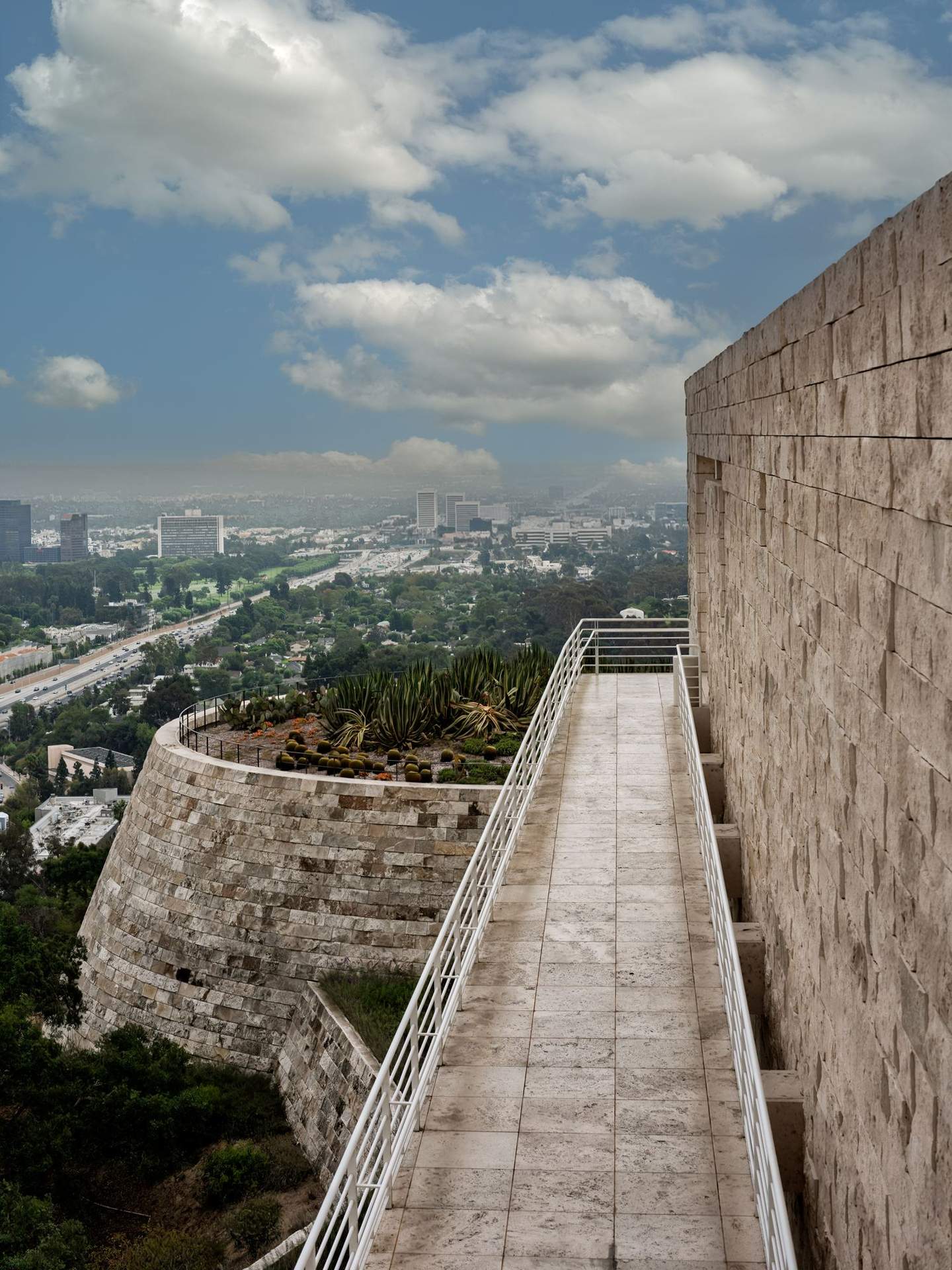
I spent the first hour just walking. Not shooting. Walking. That's unusual for me on a location I don't know; normally I'm working the camera immediately. But the Getty demands to be understood spatially before it can be photographed well. The campus is large enough that you can get genuinely lost in it, and the buildings' geometry, a complex of interlocking curves and rectilinear forms all clad in the same warm Italian travertine, means that the same wall reads completely differently depending on which direction you're approaching from and what time of day it is.
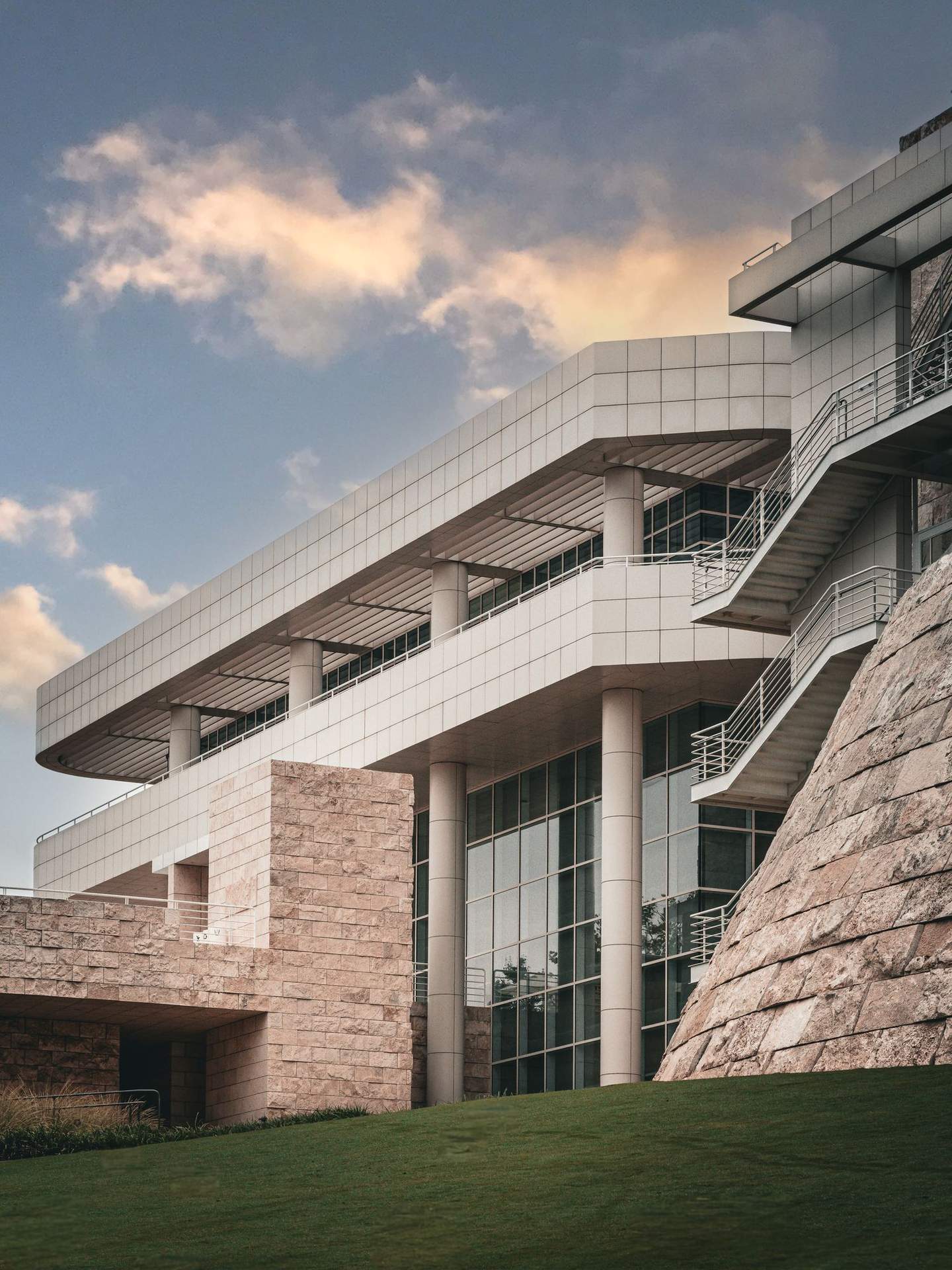
The travertine is the material story. Meier sourced it from a quarry in Bagni di Tivoli, the same source the ancient Romans used for the Colosseum. The stone is cleft-cut, meaning each panel retains the natural texture of the rock face, and the panels are set in a consistent grid with precise reveals between them. At a distance the buildings read as monolithic, massive, unified, almost sculptural. Up close the surface becomes something else entirely: a map of geological time, every panel slightly different in its fossil content, its striations, its color variation within the narrow warm-ivory range Meier specified.
One lens for three hours meant I couldn't chase details without committing to a position. The 55mm on the X2D is a disciplining focal length, close to what the eye actually sees, unforgiving of weak compositions, impossible to use as a crutch. Every frame had to be earned by finding the right place to stand.
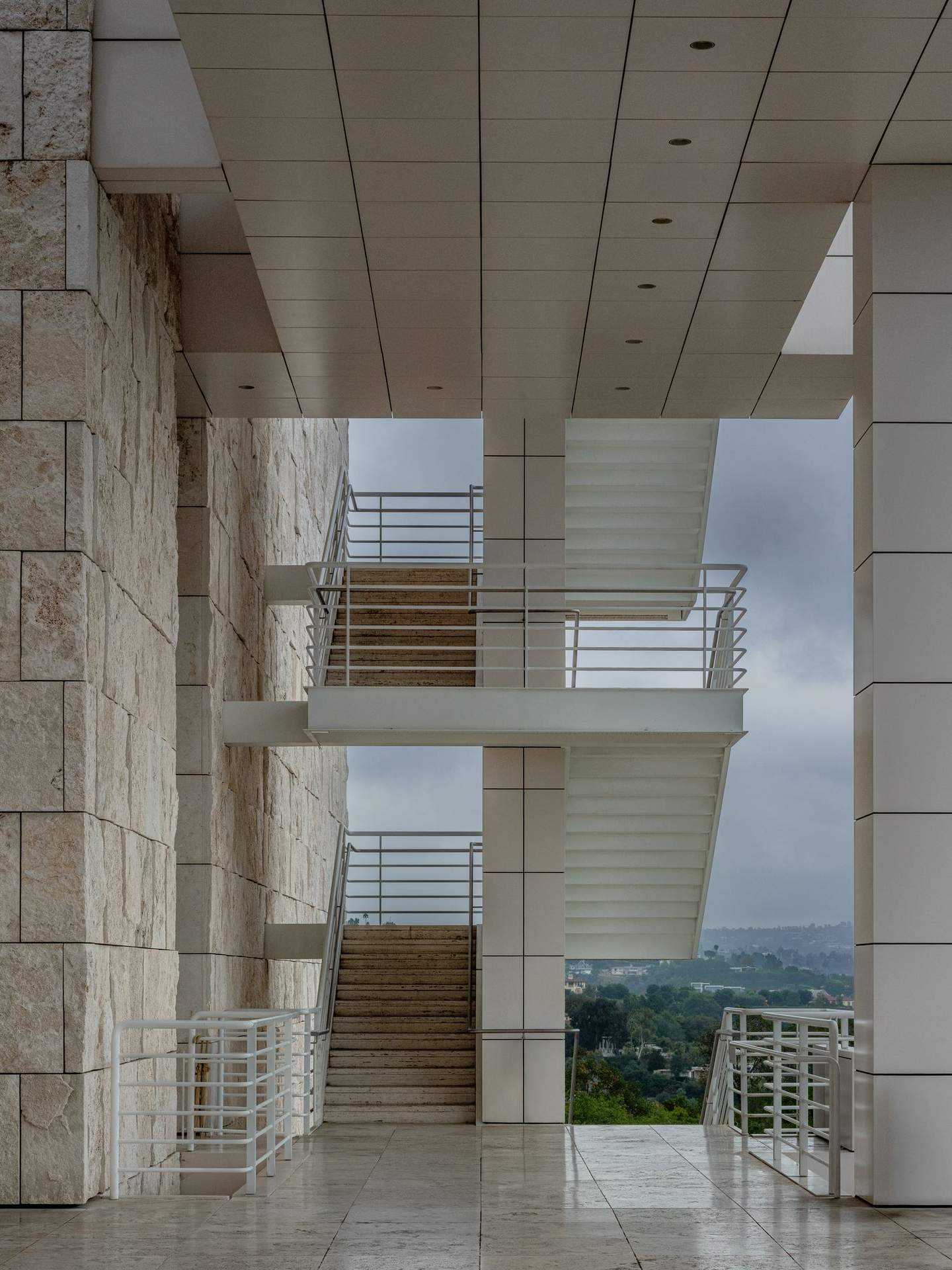
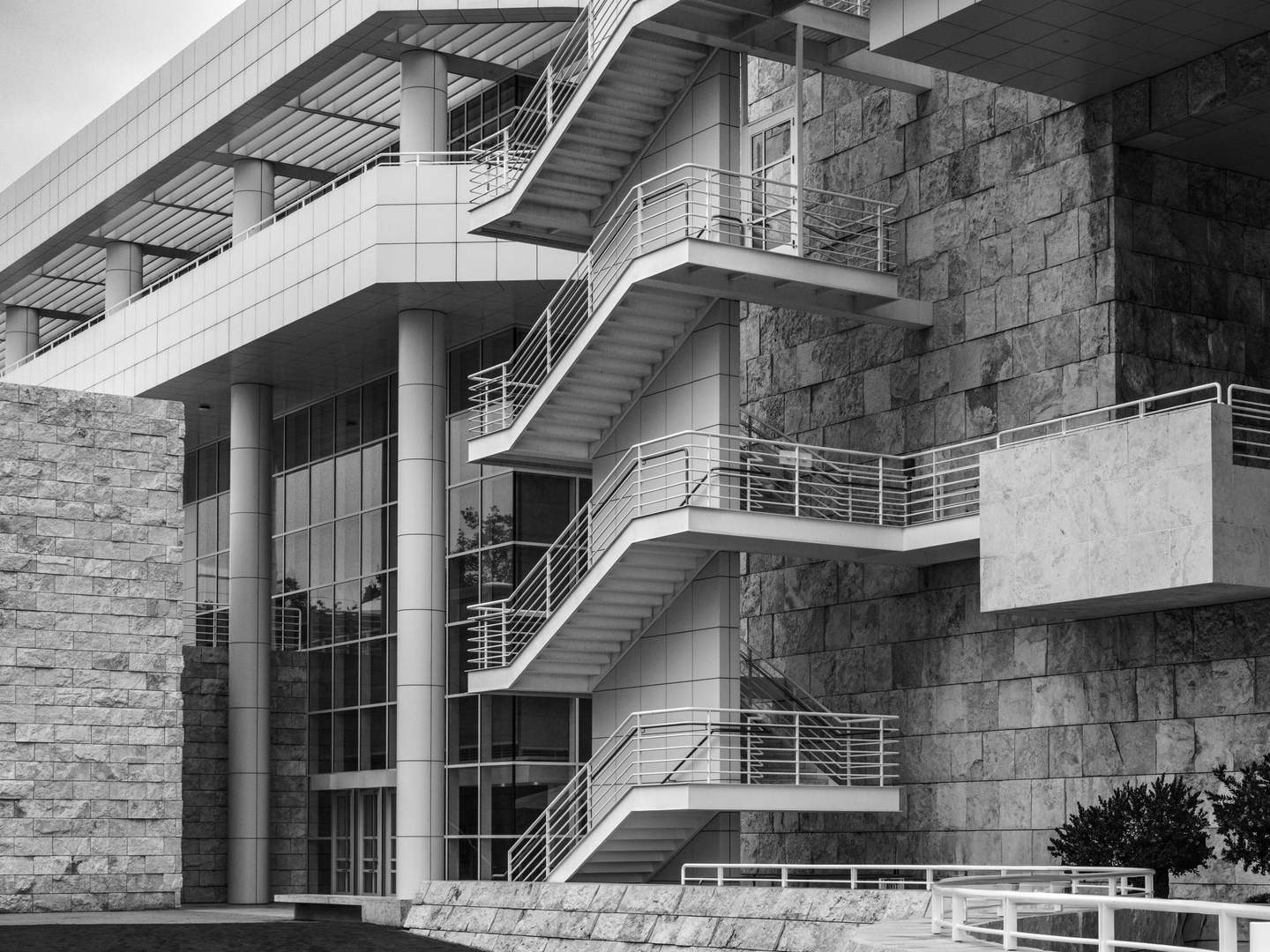
The exposed staircases became my primary subject. Meier uses them throughout the campus as both circulation and architectural punctuation, open steel-and-travertine structures that project from the building faces, fully exterior, with views at every landing. They're intensely graphic: the diagonal of the stair run cutting against the horizontal grid of the cladding, the handrail cables creating fine vertical lines, the landings projecting as horizontal planes into open air. In photographs, they have the quality of a technical drawing made three-dimensional.
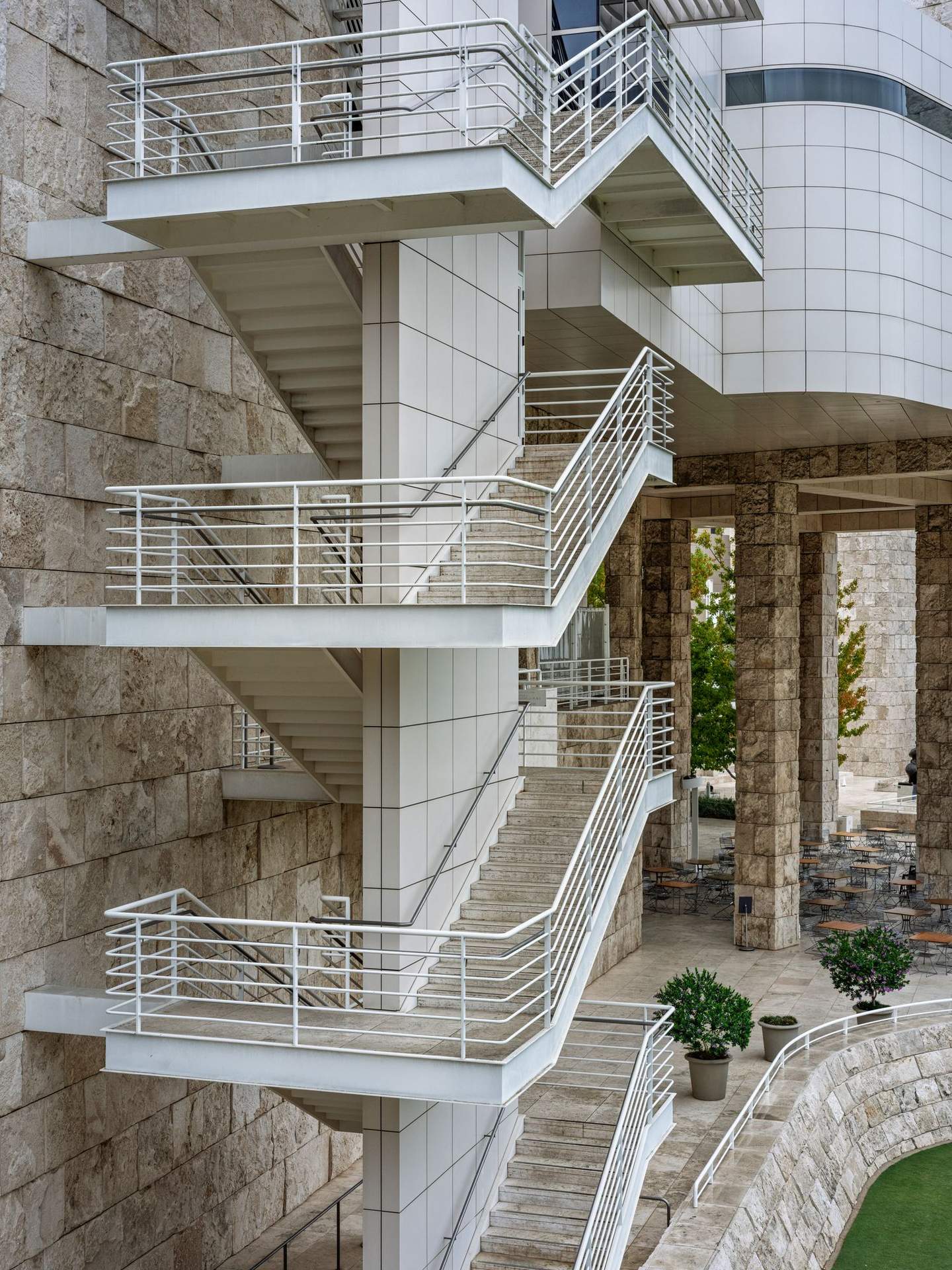
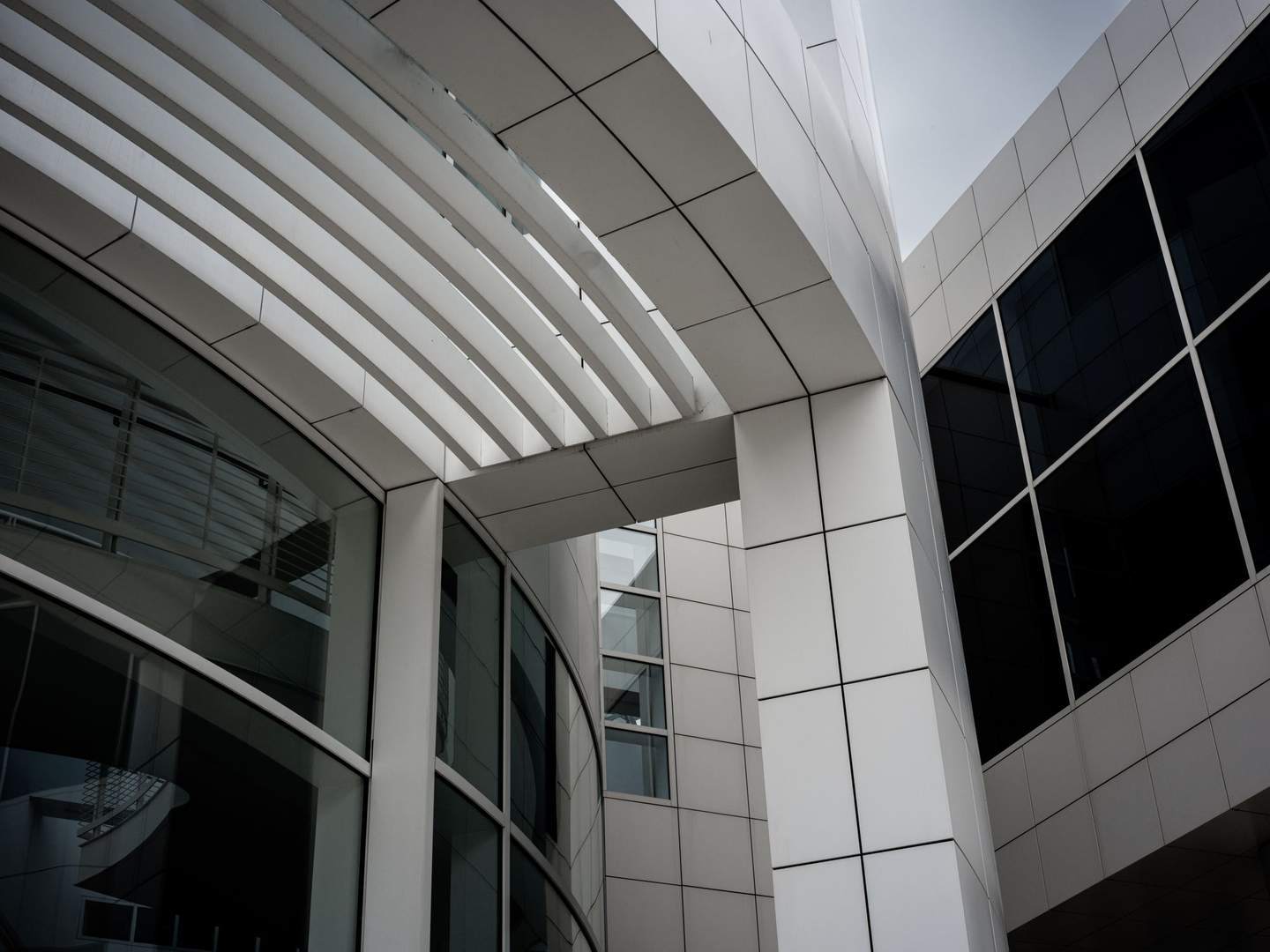
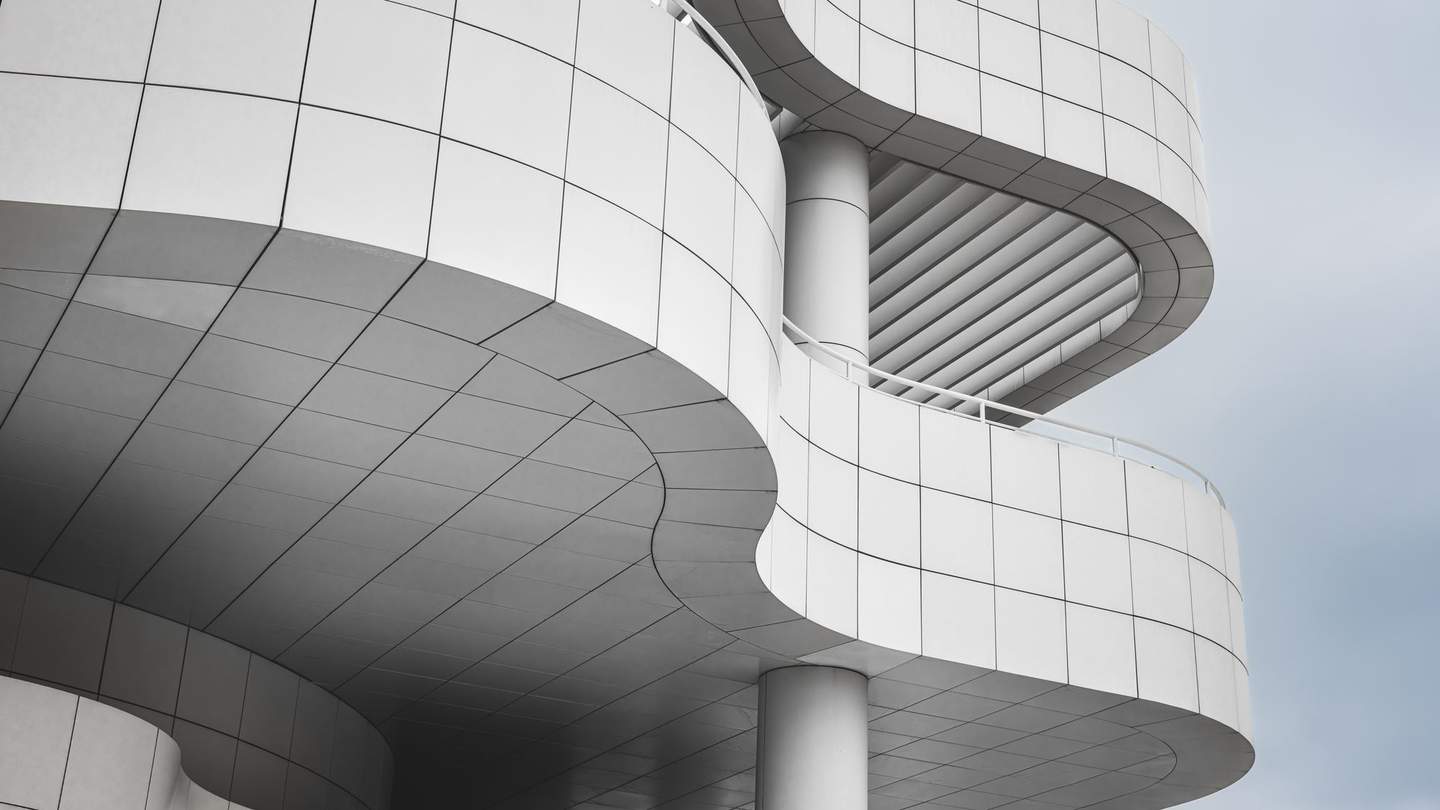
The overcast morning was a gift. The Getty in direct California sun can be brutal: the travertine is highly reflective, the white enameled aluminum panels on the curved sections blow out easily, and harsh shadows cut across the facade geometry in ways that flatten rather than reveal. Diffuse overcast light wraps the stone, reveals the texture of the cleft-cut surface, and holds detail across the full tonal range of a facade that spans from deep shadow in the reveals to the pale ivory of the lit travertine faces. When the clouds broke briefly in the late morning, the light lasted four or five minutes before closing over again. I used every second of it.
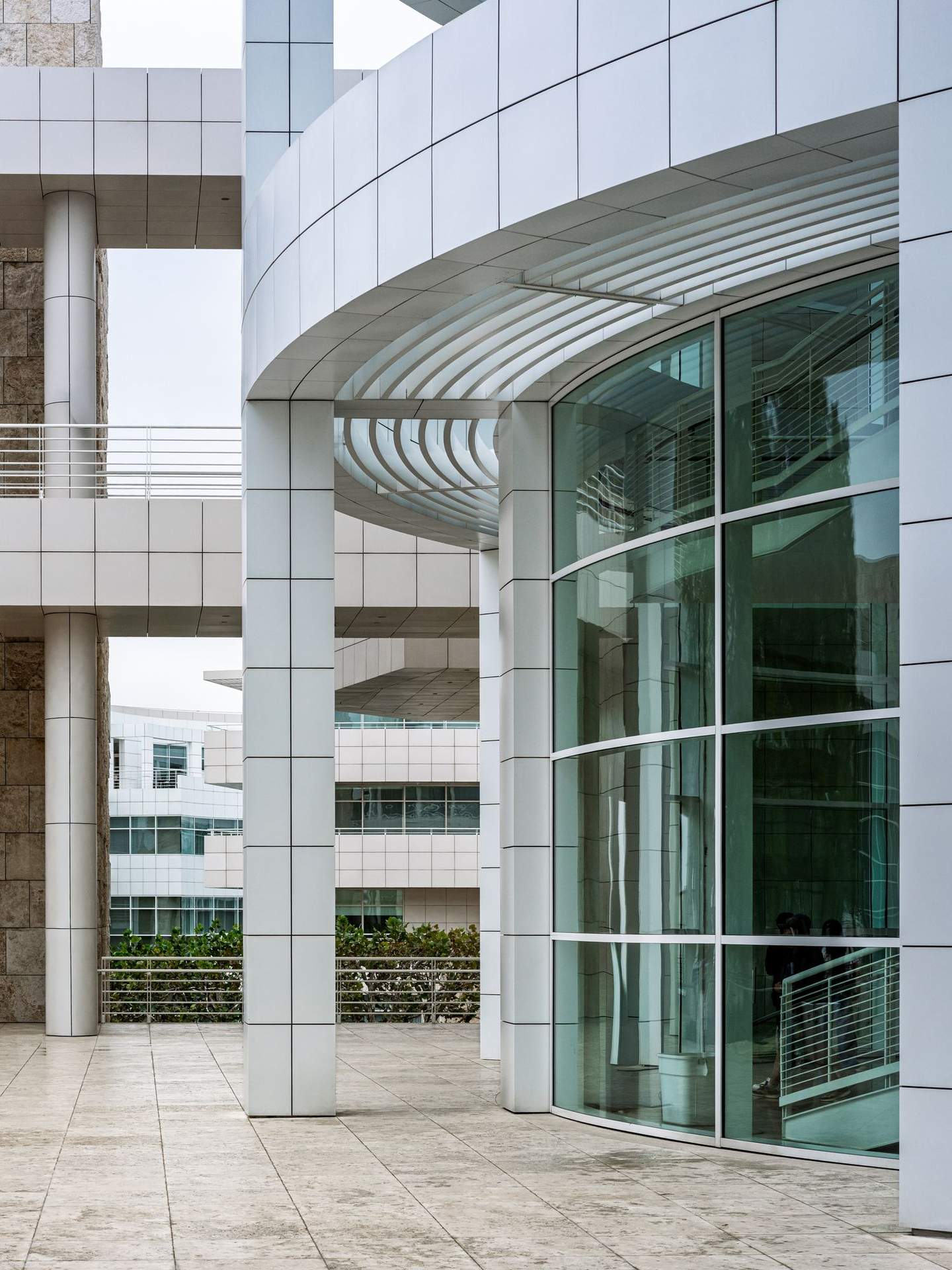
"Meier held a coherent material and formal vocabulary across 24 acres and six major buildings without a single moment of inconsistency. At that scale, that kind of restraint is extraordinarily difficult to maintain."
What I keep coming back to about the Getty is the discipline. Meier held a coherent material and formal vocabulary across 24 acres and six major buildings without a single moment of inconsistency. The travertine, the white enamel, the open circulation, the curved forms against the rectilinear grid: it's the same grammar from the parking structure to the garden to the main gallery pavilions. At that scale, that kind of restraint is extraordinarily difficult to maintain. It requires a client willing to hold the line and an architect confident enough not to reach for variety as compensation for a weak idea.
The Getty has neither weakness. It is one of the few buildings I've encountered where the ambition of the concept and the quality of the execution are genuinely matched.
I left before noon without having stepped inside a single gallery. I'll go back for the art eventually. But the building is reason enough to make the trip.
Tags