I didn't go to Mexico City to photograph a library.
The Vasconcelos wasn't on a shoot list. There was no client brief, no art director, no deliverable. I had a free afternoon in Buenavista, I knew the building was nearby, and I walked in with a Hasselblad X2D and no particular plan. What I found inside stopped me for the better part of three hours.
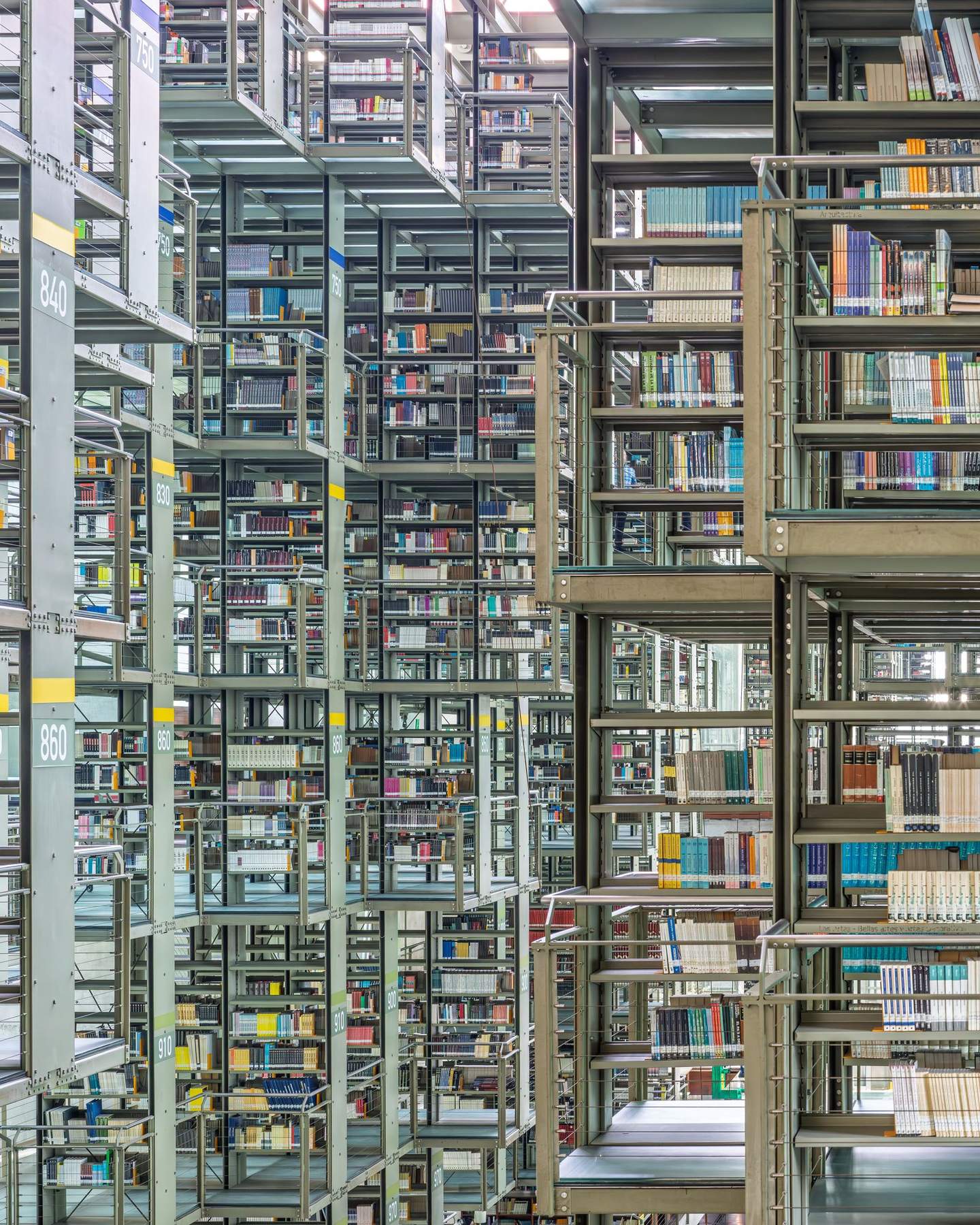
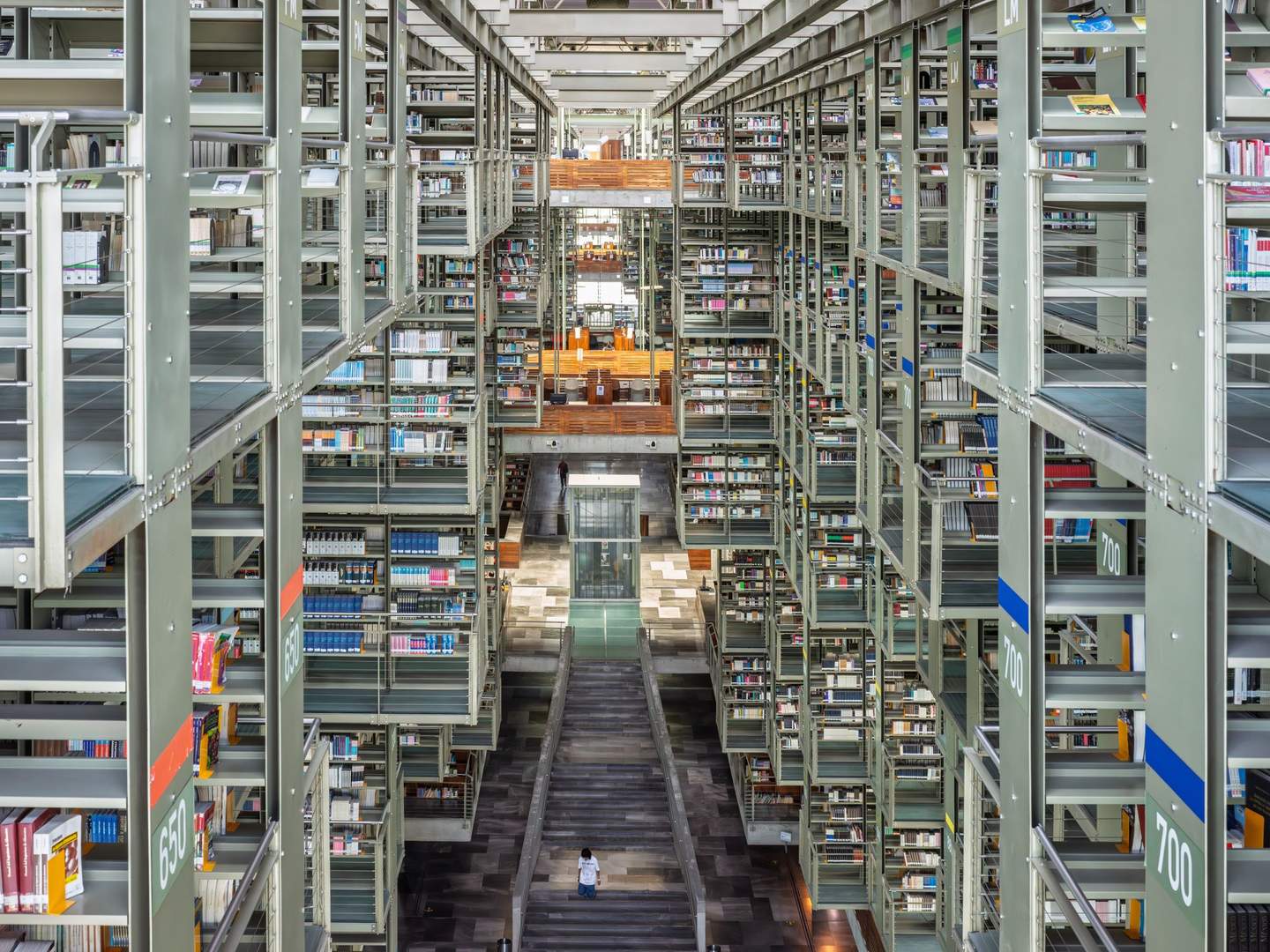
Biblioteca Vasconcelos, designed by Alberto Kalach and completed in 2006, is one of the most spatially ambitious public buildings in Latin America. The central idea is radical in its simplicity: suspend the entire book collection from the ceiling. Rather than shelving books along walls, Kalach engineered a series of steel-framed platforms that hang from the building's roof structure, cable-tensioned and cantilevered into the central void. The result is a building where the books are architecture, where the collection itself becomes the structural language of the space.
From a photography standpoint, this creates a problem that takes time to solve.
The obvious shot (everyone takes it) is the ground-floor wide showing the whale skeleton mounted above the central staircase with the stacks rising on both sides. It's a strong image and I shot it. But the building's real photographic intelligence lives elsewhere: in the structural logic of how the stacks are hung, in the way natural light migrates through the glass walkway platforms between levels, in the relationship between the industrial engineering and the human beings navigating it.
I spent the first hour figuring out the building's geometry. The stacks are suspended in two parallel rows flanking a central circulation spine. Bridges connect the stacks to the concrete core at each level. The walkway platforms are glazed, teal-green tempered glass, which means light passes through them, landing differently at each level depending on time of day. Moving vertically through the space, the quality of light changes completely floor by floor.
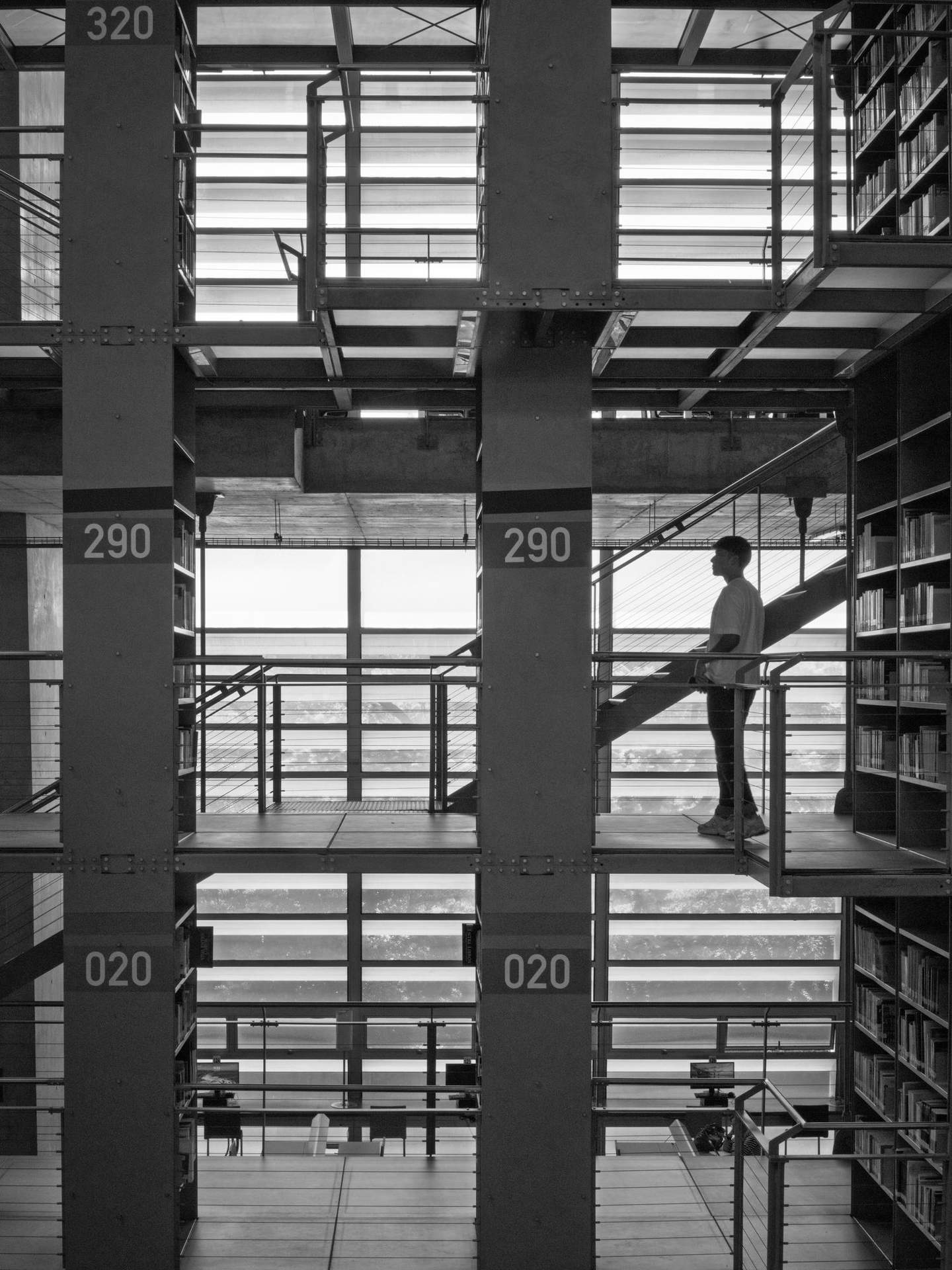
The architectural photographs that interest me most are the ones where the building makes a person feel something about space and scale, not just records of what a building looks like, but images that transmit the experience of being inside it. At Vasconcelos, that experience is vertigo. Not the unpleasant kind, but the particular disorientation of standing inside a system that is simultaneously vast and intricately detailed.
Finding the right angles required going vertical. The building's upper walkways are accessible to the public, and from the higher levels the suspended stacks reveal their structural logic in ways that ground-level photography can't communicate. Looking down through five levels of cantilevered platforms, each with its own glowing glass floor, each populated with a different arrangement of books and readers, the building stops looking like a building and starts looking like an engineering diagram of itself.
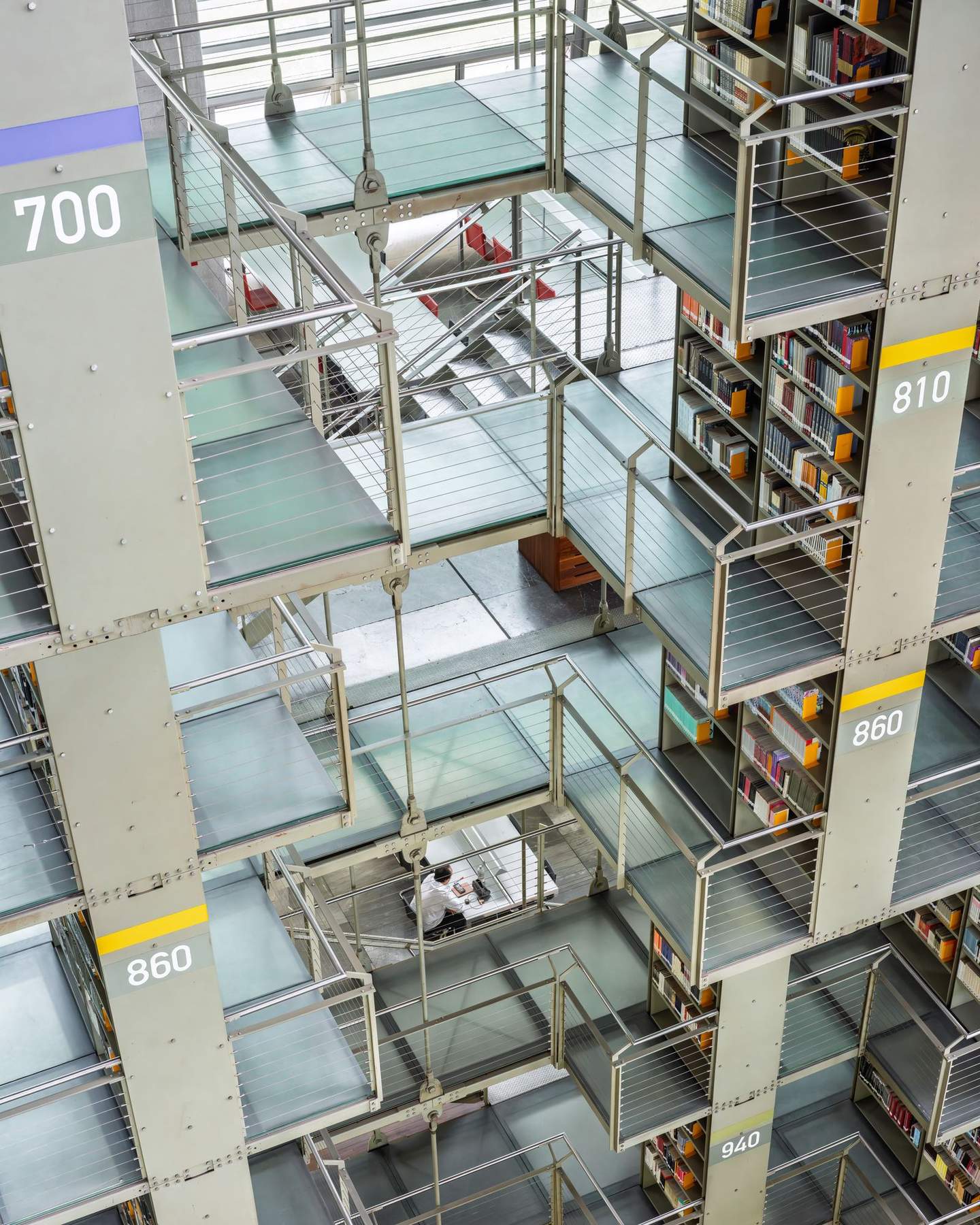
"The lone figure at the table, absorbed in work and completely unaware, was exactly the human anchor the frame needed. The architecture was doing something extraordinary overhead, but without that person it would have been an engineering drawing. With them, it became a photograph about what libraries are for."
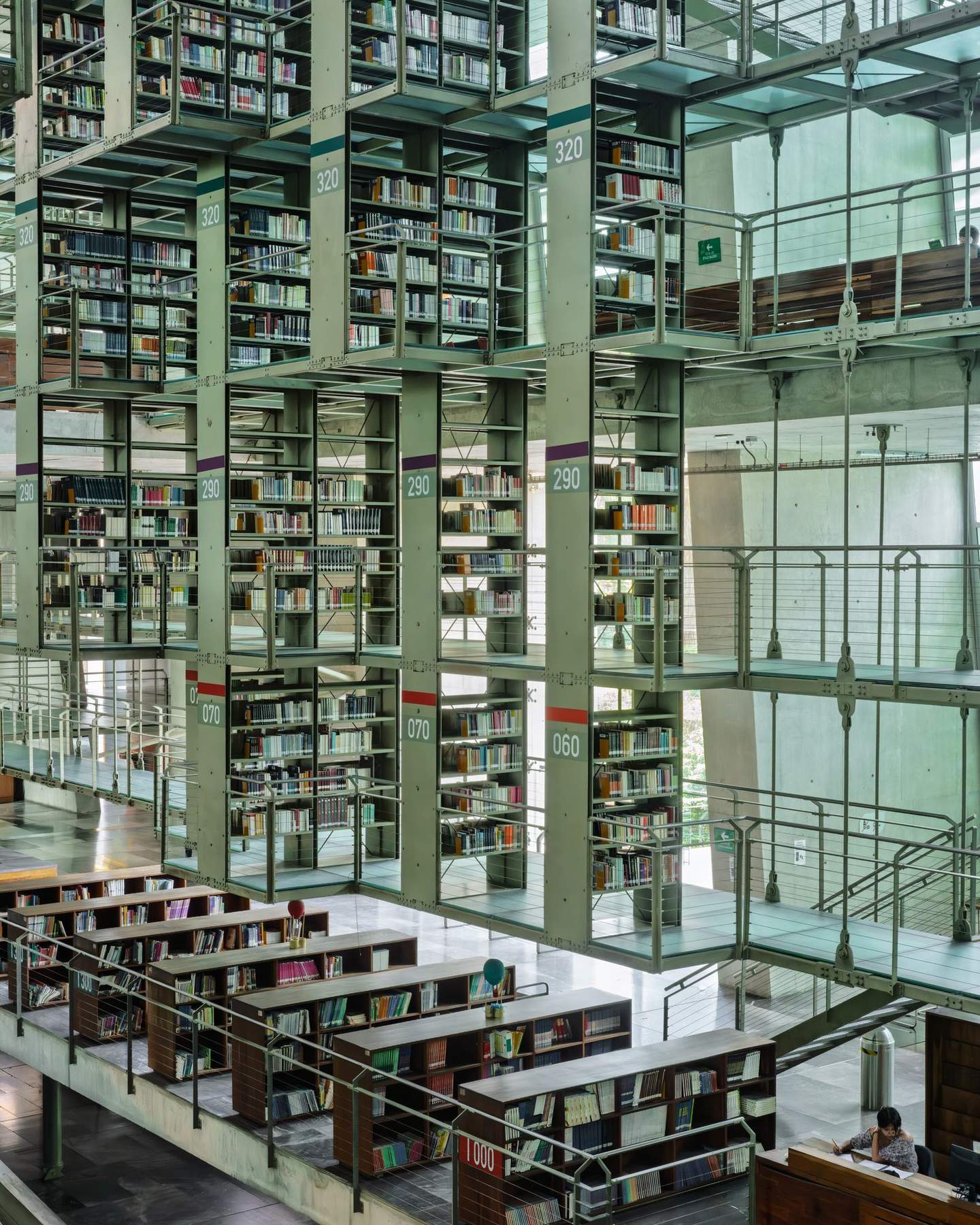
I shot the central nave symmetry image from the same walkway level. Finding the precise centerline took several attempts: the building is wider than it appears from inside, and even a few centimeters off-axis destroys the bilateral balance. When it locked in, the composition essentially built itself: the staircase as spine, the stacks as walls, the warm wooden reading room terminus as focal point, two figures at different levels providing scale without demanding attention.
The B&W conversions came later, in post. Several of the interior spaces, particularly the perimeter circulation corridor and the structural corner details, read better without color. The concrete core has a weight and texture in monochrome that color processing tends to flatten. And the human figures in the B&W frames read with more graphic clarity, as silhouettes rather than people, which suits the scale of the architecture they're inhabiting.
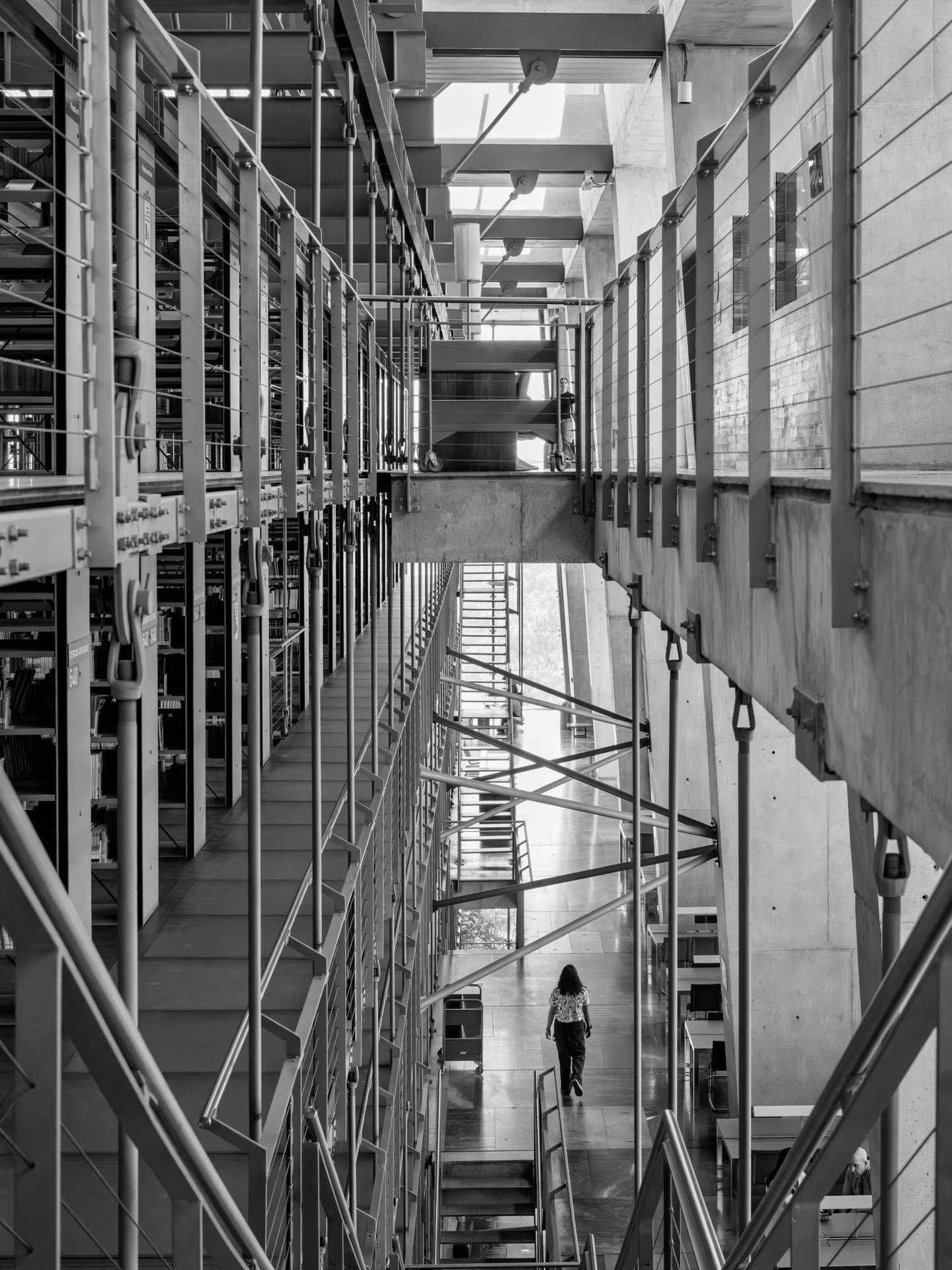
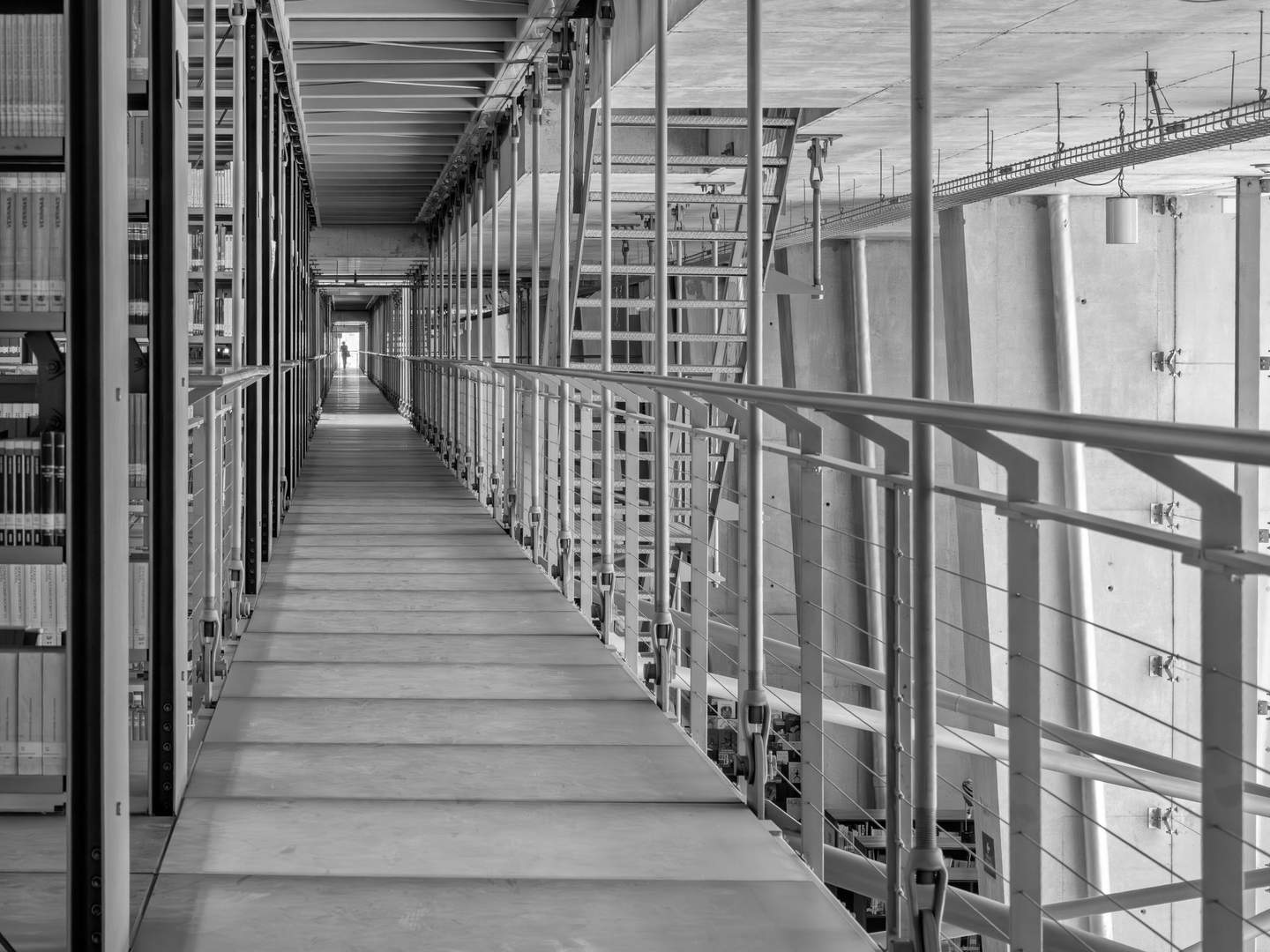
What strikes me most about Vasconcelos, in retrospect, is how deliberately Kalach designed it to be experienced vertically. Most libraries are horizontal, rooms opening onto rooms, a single floor or a small step up to a mezzanine. Vasconcelos forces you upward. The staircase at the center is the building's main event, and the experience of ascending through the stacks, each level revealing a new view down to the levels below and up to the levels above, is the spatial idea the architecture is built around.
That verticality is also what makes it so difficult to photograph. A single image can't contain it. You need multiple frames from multiple elevations to begin to communicate what the building actually does to a person standing inside it. The selection here represents maybe six or seven of those moments, enough, I hope, to suggest the rest.
Biblioteca Vasconcelos isn't a commission I'll ever shoot; it's a public library, and its photography isn't for sale. But it's one of the buildings that most clearly defines what I'm looking for when I point a camera at architecture: the moment when a structure reveals its own logic, and a human being inside it reveals just how large that logic actually is.
Tags